Viewing archives for Blog

Date: Monday 27th June 4:30 – 6pm (on Zoom)

This free online webinar session hosted by the RE Council of England and Wales aims to answer the following questions:

  1. What do we mean by an education in religion and worldviews?
  2. How does the REC’s new free draft handbook support the development of
    high-quality syllabuses in RE?
  3. Why should multi-academy trusts invest in the teaching of religion and
    worldviews as part of the curriculum

Introduction:
Religious Education is on the cusp of a major shift as significant as that which took
place in the 1970s when it changed from being largely Christian based to being a
multi-faith study. This recent shift was initiated by the publication of the Commission on RE Report in 2018 that recommended a worldviews approach. Since then, the Religious Education Council has been active in exploring the implications of this change, publishing a range of resources. This webinar will explore the implications of this shift to a worldviews approach for RE in MATs, looking at how it offers a scholarly up-to-date approach which is academically rigorous and personally inspiring for all students, whatever their own background.

Presenters:
Dr Trevor Cooling Is Emeritus Professor at Canterbury Christ Church University. He has been involved in RE for his entire career spanning 50 years. He is widely published in both academic and professional books and journals. Between 2015 and 2021 he was Chair of the RE Council and has been intimately involved with the Religion and Worldviews initiative.

Dr Kathryn Wright is chief executive of Culham St Gabriel’s Trust, an endowed charitable foundation which promotes a broad-based, critical, reflective education in religion and worldviews. Kathryn leads their strategy and works with a range of partners. Kathryn is a former local authority and diocesan education adviser. She sits on the Board of the Religious Education Council of England and Wales.

To reserve your place, please contact: info@religiouseducationcouncil.org.uk

To download a flyer click here

Last term we ran a pupil competition to find out what difference an education in religion and worldviews makes to children and young people. From next week you will be able to read and listen to some of them talk about this, but here I want to give a few reflections of my own based on some of the fantastic entries we received. You can also find a list of all the winners and those highly commended at the end of this blog.

An education in religion and worldviews changes attitudes and promotes positive values

Children and young people who entered our competition spoke of the ways in which it increased their sense of empathy towards others, as well as respect and openness towards differing perspectives. Some stressed an even stronger notion that their lessons can promote social justice, dispelling stereotypes and showing that freedom of religion or belief is vital to uphold in our society. Bea and Laurie used a lovely phrase ‘treasuring people’, going beyond a sense of tolerance to deep appreciation of others.

An education in religion and worldviews increases our knowledge and understanding of the world

We live in a complex world, one which is hard to navigate. Children and young people see the value of an education in religion and worldviews in terms of understanding human beings and the world in which we live. They talk about history and meaning, understanding symbolism, learning from great minds, and exploring the nature of wisdom itself. Chloe talks about the way in which her increased knowledge and understanding led to a more enriched experience on a holiday trip where she could apply her learning practically and reflect upon it.

An education in religion and worldviews inspires young people to think critically and make a difference

A common thread through many of our entries was the idea that lessons enabled pupils to think and act in new ways. Zara says her ‘brain was about to explode’; whilst Amelie says her lesson was ’eye opening’ and ’boggled her mind’! There was a sense of emotional engagement by many pupils, particularly when lessons had an element of mystery or surprise. Some talked about the way they had been inspired by people who had made a difference to the lives of others; this had led them to consider how they might make a difference in their local community, society or the world.

I will end with a quote from Zara (Key Stage 3), who sums up for me why an education in religion and worldviews can make a real difference:

This lesson taught me the importance of asking important questions to not only have a better understanding of yourself and the nature of the world around, but to be able to use that knowledge to build a better world.

Winners

Alexander, Felton CE Primary School

Bea and Laurie, Broomwood Hall Upper School

Harriet, Felton CE Primary School

Ramya, Warren Road Primary School

Zara, Felton CE Primary School

Chloe, St James Senior Girls’ School

Joseph, Hethersett Academy

Lili, Woodford County High School

Amelie, Kings Norton Girls’ School

Zara, St James Senior Girls’ School

Highly Commended

Finley and Cole, Hethersett Academy

Shreya, Plashet School


Thank you to everyone who entered our 2022 competition. The judging teams had difficult decisions to make. Congratulations to all the winners.

This short briefing paper sets out some of the ways in which the RE (religion and worldviews) community can support Teaching School Hubs. This includes providing subject specific knowledge of policy about the subject, content knowledge, pedagogical knowledge and opportunities for teachers to engage with educational theory and research.

The briefing paper has been produced jointly by: The National Association of Teachers of RE, The Religious Education Council of England and Wales and RE Today Services. Their work is supported by Culham St Gabriel’s Trust.

I attended a parliamentary roundtable event earlier this week. One of the aims of the event was to advocate for a National Plan for Religion and Worldviews. There were various speakers at the event including the comedian Paul Kerensa, and Professor Francesca Stavrakopoulou, as well as pupils from two secondary schools. However, the message that came across from all contributors was the importance of an education in religion and worldviews for developing critical thinking and social skills, as well as helping children and young people understand what it is be human within a globalised, ever-changing society.

Alongside this recent Culham St Gabriel’s ‘In conversation’ events this term have demonstrated ways in which the religious and non-religious landscape is continually changing. This is partly due to the Covid pandemic, but also due to increasing diversity of worldviews. People are expressing their worldviews differently and interacting in new ways with members of their worldview communities. I am reminded that an education in religion and worldviews will always be one ‘in transition’. For me, this makes it even more important that we equip children and young people to navigate this complex world.

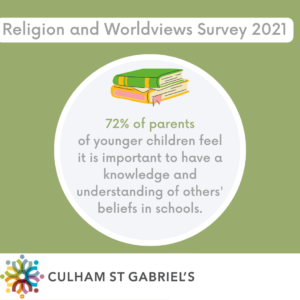
I am sure we would all agree that at this moment in history there is much uncertainty. There has never been a more significant time to understand one another, to be well-informed, sensitive, and diplomatic in our interactions. An education in religion and worldviews not only has much to offer into this context but is, I believe, a vital ingredient. It is worth noting that most parents in our 2021 survey also grasped the importance of the subject.

So I’m looking forward to our pupil competition entries (Deadline 14th March) on the theme ‘Lessons that make a difference’. We believe that an education in religion and worldviews really does make a difference. It not only informs, which is crucial, but enables children and young people to become thoughtful and critical participants in public discourse. As they receive a quality education in religion and worldviews, we hope they will recognise individual needs and be respectful of divergence and diversity of perspectives. We hope they will be discerning and appreciative of the contribution that many worldviews make to society. And we hope that they will also develop their own personal knowledge, becoming more self-aware and mindful of their own worldviews and their effect on actions, decisions and social interactions.

To enter pupil’s blogs and vlogs in our competition please visit:

www.reonline.org.uk/news/pupil-blog-competition-2022/

NATRE are currently recruiting for a Lead Director of Regional Hubs. Details of this part time role can be found on NATRE’s website.

Next week is Chinese New Year, and 2022 will be the Year of the Tiger. It seems quite appropriate therefore to be launching the opening of applications for our leadership programme 2022-23. Those born in the year of the Tiger are deemed to be natural leaders, who are active and ambitious. They are also said to have a sense of justice and fairness and to be very trustworthy. However, they can also be overconfident and get frustrated by failures.

One of the characteristics of our leadership programme is that it doesn’t matter whether you were born in the Year of the Tiger or not, we aim to help you find your own voice as a leader. We help you to identify your strengths, and work through areas of development. I was born in the Year of the Rat (you can work out how old I am, but let’s just say I have a big birthday later this year…). Characteristics of those born in the Year of the Rat are optimism, energy, and stubbornness! I will let others be the judge as to whether this is the case or not! However, one thing is clear, we all bring a different set of gifts and talents to our roles as leaders. In the religion and worldviews community, we need this diverse mix of skills and expertise to bring about the systemic change needed at this important time for the subject.

One of the most interesting books about leadership I have read is Inspirational Leadership: Timeless lessons for leaders from Shakespeare’s Henry V by Richard Olivier. As Olivier tracks Henry’s journey as a leader, he shows how the nature of his leadership changes as he encounters new challenges and issues. At different stages in his leadership journey, he is authoritative and analytical, at others he is building relationships and empathising. He is both a visionary, but also nurtures. He is someone who gets things done, meeting his targets, yet also spends time celebrating victory! Our leadership programme brings participants together through a community of practice. This enables individuals to share their own journeys, their strengths, and personal challenges in a supportive environment.

In addition, those on our leadership programme immerse themselves in an important contextual understanding of the subject. It is politically intelligent to listen to those who have moved (or are moving) in national circles and conversations. I remember doing this myself through conversations with people like Dr Bill Gent. Our participants locate themselves within the story of our subject, engaging with their experienced mentors who in many ways are like storehouses of wisdom, sharing the narrative of our subject over time.

However, there is one characteristic of leadership I believe to be vital. This is a sense of service. And by this, I mean a desire to serve the common good, to leave the world (of religion and worldviews) in a better place. When we have this at the heart of leadership we value diversity of thought, we create a culture of trust, and we aim to empower and foster the leadership of others. So are you ready to serve?

Find out more and apply for the leadership programme: https://www.reonline.org.uk/leadership/leadership-programme/

The Religious Education Council of England and Wales (REC) is a national charity which campaigns and advocates for high-quality education in religion and worldviews. Their vision is for every young person in England and Wales to experience academically rigorous and personally inspiring Religious Education (RE).

After a strategic review, the REC Board of Trustees now needs an Executive Officer to report to the Chair of the Board and to lead the delivery of their new strategic plan.

Full information can be found on the REC’s website here

Advent (which began officially on 28th November) is traditionally a time of waiting, although the actual word comes from the Latin, adventus, or ‘coming’. This time of year, there are many festivals, including Hanukah, Bodhi Day and the Winter Solstice many of which feature the concept of light overcoming darkness. RE:ONLINE’s festival calendar provides some useful information on these celebrations and seasons, as well as links to resources.

As I write this blog I’m beginning to look ahead to next term and Culham St Gabriel’s plans for the New Year. It feels very much like a time of waiting before we launch new things in January. So, I thought I’d give you a bit of a preview, so you know what is coming!

We have a very exciting line up for our ‘In conversation…’ events. Although it happened largely by accident, there is a distinct society and culture theme to the research being shared next term. We will be hearing about research undertaken in different worldview communities during the pandemic and how this has impacted on expressions of belief. We will be hearing about digital expressions of worldviews, decolonising teaching about Jesus in primary schools, and learning more about how we might map ‘sacredness’. Lastly, the Jewish Museum London will be sharing more about their project exploring diversity and inclusion in curation.

We have just published details for most of these on our website and you can sign up here.


Leadership Programme and Masters Scholarship logos


At the end of January, we will be opening up applications for our leadership programme and our Masters scholarship programme (both beginning September 2022). We will share more details about these in our newsletters, and on our websites. We are delighted that some of the leadership programme team and participants will be sharing more about what is involved at one of the Strictly RE twilight events.


Lastly, after much consideration we are going to hold a second RE:ONLINE Competition! More details to follow, but the theme in 2022 will be ‘Lessons that make a difference’. We will be accepting both written and audio-visual entries this year. If you’re a teacher, you may want to plan in some time for your pupils to enter next term!!

So, you will now have to wait… but at least you know some of the things that are coming!

To get all the latest information make sure you are signed up to our latest newsletter here

Some thoughts on the role of a curriculum leader for religion and worldviews

Over the last week I have been at various events around the country talking about and listening to various conversations about curriculum. I have heard curriculum leaders for religion and worldviews compared to a juggler, and to contestants of Bake Off! However, I have another analogy which I have found helpful in my reading over the last month.

I have recently read a book called Modern Grant Making: A guide for funders who believe better is possible. This sets out some very helpful thinking for charities and foundations around the value of service. How are we serving others? They point out that sometimes grant funders design their grant making policies and processes and do not revisit them for many years. They tend to assume that everything still works for everyone. They use the analogy of an architect, saying that it is like designing a house and building it. However, after living in the house for a while, the client realises that the stairs are in the wrong place. Having probably spent quite a lot of time and money they ‘live with it’ for some time, perhaps years, before deciding to make any changes.

The authors go on to say that charities and foundations need to be take an attitude of service, where they constantly evaluate and re-evaluate what they do, developing continually new and improved iterations of policies and practices. They compare this to a chef. A chef provides service daily to their customers. They are continually providing the best service possible. They refine their menu, improve recipes, rethink ingredients and so on. It is an iterative process daily. I found this a very powerful analogy as someone who oversees a charitable foundation.

I wonder though if this analogy is also helpful for curriculum leaders of religion and worldviews. Are we more like architects where we design a curriculum, and then leave it for some time before we revisit it? Or are we more like chefs who understand that it is a continual process of designing and redesigning? Having been involved with the development of the Norfolk Agreed Syllabus (2019), there are things I would now change or amend. My own wrestling with the subject has grown, and I want to apply my new learning.

My sense is that we need to be more like chefs. We need to realise that a curriculum is not static. It is constantly moving and shifting. It needs to consider changing contexts, but also the transitional nature of religious and non-religious worldviews themselves. If we engage in and with scholarship, we must surely apply this to our settings through an iterative process. In addition, I wonder if we reframe out thinking about curriculum in terms of service. How are we serving the children and young people in our schools? Are we continually offering the best diet possible to enable them to become religiously literate? To become expert interpreters of religion and worldviews?


Reference:

https://moderngrantmaking.com/

Between 2018-2020 a grant was awarded to RE Today Services by Culham St Gabriel’s Trust and The Jerusalem Trust to develop an infrastructure of regional support across 10 regions in England. The aim was to gather and support hub related initiatives through 10 regional ambassadors, under the leadership of a national ambassador. St Peter Saltley Trust has also funded important continuing development aspects of this project.

This project had much success including:

  • Increasing networking, communication and information gathering across regions
  • Increasing in the number of local groups supporting those teaching RE and practitioners
  • Providing platforms for CPD
  • Increasing in attendance at local groups due to online meetings
  • Increasing in number of NATRE affiliated groups
  • Development of a new website Regional Hubs website (to be launched with the new initiative)

The funding was for a two year project and through the evaluation development opportunities have been identified to progress this initial project to better meet the perceived needs in the RE/R&W community over the next three years.

We have developed a Theory of Change to support the next steps for the project as follows:

Overarching Aim and Impact:

The RE/R&W community working effectively together nationally (multi-nationally) and across the regions to support all teachers and leaders of the subject in a sustainable way.

Specific Aims:

To improve communication between teachers, professional development providers and resources, and research communities

To improve connections and interactions between different parts of the RE/R&W Eco-System

To increase accessibility for all teachers to local and regional professional development and research through an information exchange

To enable teachers to teach with greater confidence through their access to the support, knowledge, training and resources available in their region

To create a sustainable long-term model for future provision

Outcomes:

Improved communication between teachers, CPD and resource providers, local/regional adviser networks and research communities

Improved cohesion and strategic operations between different RE/R&W organisations and groups

Improved engagement by teachers with RE/R&W local groups/networks

Increased access to wide range of professional development locally and regionally

Secured long term funding for this project

Improved accountability lines for the project

What does this mean in practice?

In order to work towards these outcomes the following changes will be taking place from November 2021:

  • A Steering Group is being created to oversee the project and work on developing a sustainable model from 2024 onwards. This steering group will include representatives of the main RE organisations.
  • A new reimagined National Hub Leader role will be developed to lead the Regional Hub Co-ordinators, and to connect different groups and people at the highest level and look for strategic opportunities for working together
  • New reimagined Regional Hub Co-ordinators roles will be developed to connect different groups and people at a regional level, and share knowledge from the national level.
  • A well-resourced and up to date Regional Hub website, with appropriate administrative role to support and facilitate the information and knowledge exchange requirements.

This development means that the current national and regional ambassador structure and roles have come to an end. All those in these roles have been part of the conversation and have been informed of the changes; we were greatly encouraged that there is overwhelming support for moving the project in this direction. One or two are continuing with some specific events in the next few months, and all working information is being gathered to build on the success of the existing project.

The Steering group have their first meeting in November, and after this more details will be released about the new roles and how the project will work on the ground.

If you have any questions please do contact us.

Kathryn Wright ceo@cstg.org.uk

Zoë Keens zoe@retoday.org.uk