Our Vision, Mission and Strategy
Our Vision
Our vision is for broad-based, critical and reflective religion and worldviews education contributing to a well-informed, respectful and open society.
In 2026 the Trust revised it mission and strategy reflecting on the changing political, economic, social, educational and environmental context, as well as the listening to and learning from its partner organisations.
Our Mission
Culham St Gabriel’s Trust advances its vision through thought leadership and values‑driven partnership working. We advocate for high-quality religion and worldviews education by working alongside teachers, leaders and partners across the four nations of the United Kingdom. Our approach centres on building trusting relationships and co‑creating learning opportunities. Our work is grounded in accessible, research‑informed insights that enable teachers and other educational professionals to root their practice in evidence, directly strengthening teaching and educational approaches. We act from our commitment to diversity, equity, inclusion and justice, including freedom of religion or belief. In all we do, we strive to elevate and amplify a wide range of voices and perspectives, ensuring that our work reflects and honours the plurality of the communities and education contexts we aim to serve. By investing in professional development, enabling research, nurturing collaborative networks and modelling respectful listening and dialogue, we support the creation of a well‑informed, respectful and open society.
Our Strategic Objectives 2026 – 2030
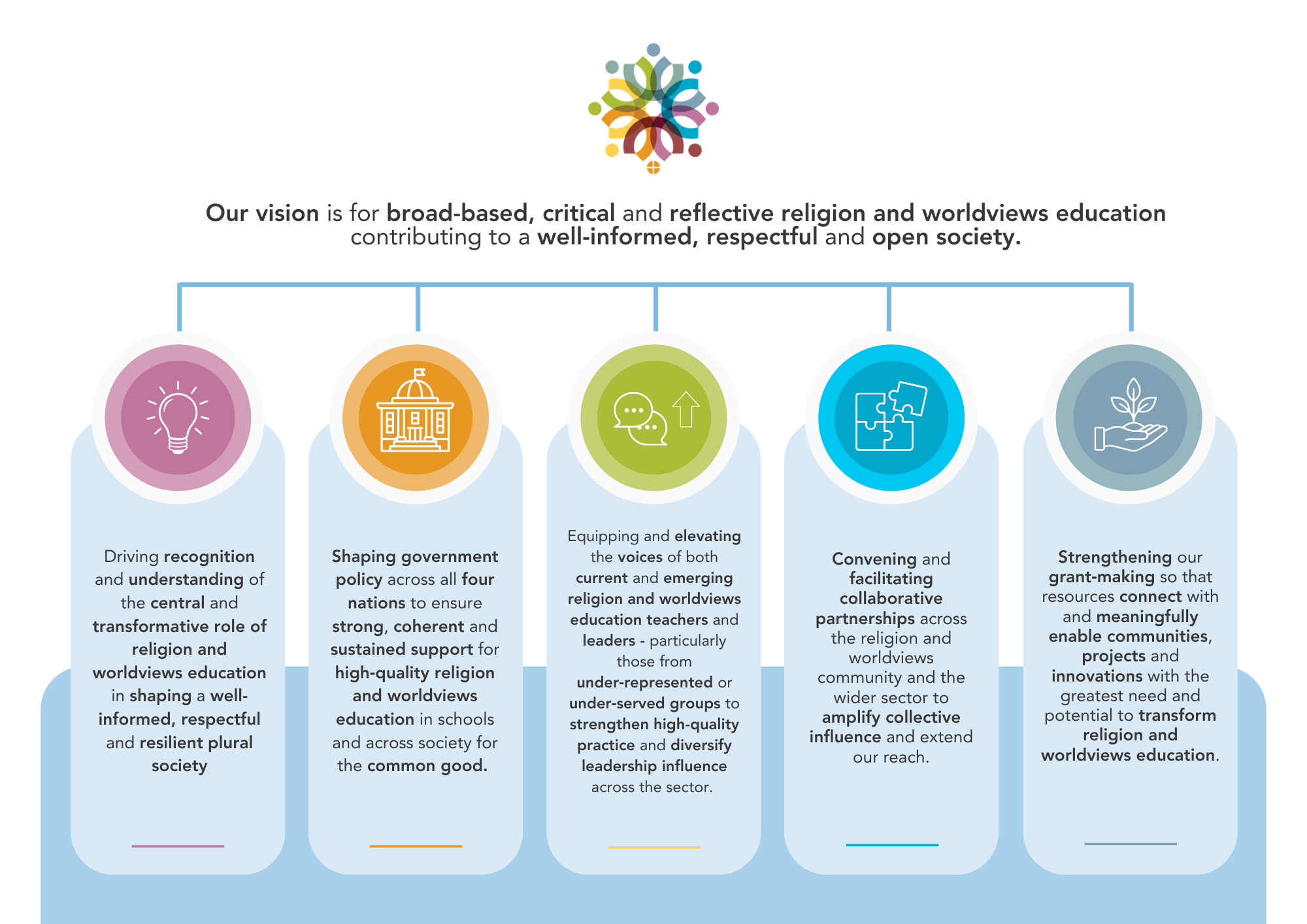
- Driving recognition and understanding of the central and transformative role of religion and worldviews education in shaping a well-informed, respectful and resilient plural society
- Shaping government policy across all four nations to ensure strong, coherent and sustained support for high‑quality religion and worldviews education in schools and across society for the common good.
- Equipping and elevating the voices of both current and emerging religion and worldviews education teachers and leaders-particularly those from under‑represented or under‑served groups-to strengthen high-quality practice and diversify leadership influence across the sector.
- Convening and facilitating collaborative partnerships across the religion and worldviews community and the wider sector to amplify collective influence and extend our reach.
- Strengthening our grant‑making so that resources connect with and meaningfully enable communities, projects and innovations with the greatest need and potential to transform religion and worldviews education.
Our Internal Priorities 2026 – 2027
- Advancing our digital, data, communications and operational effectiveness
- Developing a financially resilient and agile organisation
- Enabling and nurturing a thriving, flourishing team
Our understanding of religion and worldviews education
Culham St Gabriel’s defines ‘religion and worldviews education’ as a broad‑based, critical, reflective, inclusive, and research‑informed educational approach that equips children, young people and wider society to understand diverse religious and non‑religious worldviews, engage thoughtfully in public discourse, and contribute to a respectful, open, and plural society.
A religion and worldviews educational approach helps people understand how individuals and communities make sense of the world. It explores the rich diversity of religious and non‑religious worldviews, drawing on lived experience, culture, history and belief. This approach teaches children, young people and adults to interpret ideas thoughtfully, reflect on their own worldview, and engage with others with respect. By combining strong subject content with inclusive, reflective ways of learning, it equips people of all ages to navigate today’s diverse society and contributes to a more informed, open and respectful public life.
Culham St Gabriel’s champions the vital role of religion and worldviews education in formal schooling across the four nations, while also recognising and actively supporting its essential contribution to lifelong learning across society, engaging people of all ages and working across a diverse range of sectors.