Viewing archives for Blog

We have produced a new leaflet designed to support secondary teachers returning to Religious Education (RE) after maternity or paternity leave. The leaflet offers tailored support to help teachers re-enter the classroom with confidence, whether you’re looking for CPD opportunities, useful research articles or key religion and worldviews updates, this resource is here to assist you in your transition.

Download the leaflet below and discover how we can support your return to RE teaching!

The RE Policy Unit will be attending the Labour Party Conference between Sunday, 22nd and Wednesday, 25th, and we want to talk to people about the importance of high quality RE for all pupils, recruitment and retention of RE teachers and much more.

Our best chance of encouraging MPs to visit our stand is if a constituent asks them to do so. If you have a labour MP -please contact them, either by email (find the address here) or via social media using the assets linked below. Simply tell them that RE is important to you and you want them to visit the Religious education stand (F12) at the Party Conference.

In my research of the month, I talk about a hospitable approach to religion and worldviews, and a pedagogy of embrace. Someone pointed out to me this week that in many ways this was ‘lived out’ recently when photos emerged of Muslims embracing protesters outside UK’s oldest mosque in Liverpool.

Creating space, encountering others and listening for wisdom lie at the heart of what I propose as a hospitable approach to religion and worldviews education. I use the analogy of an embrace to capture the heart of what this means not only in terms of pedagogy, but in terms of what it means ontologically for those enacting the embrace. It seems to me this approach is needed more than ever before.

I was on holiday in Portugal when the horrifying scenes in many cities across the UK emerged on my social media feed. On Culham St Gabriel’s social media feed, we got behind the Faith and Belief Policy Collective Statement which so clearly articulated how many of us feel in the charity sector and faith and belief space. We held on to and continue to hold onto hope and love amidst the displays of hate.

At Culham St Gabriel’s our vision is for a well-informed, respectful and open society.

In a recent board meeting, prior to the recent riots, trustees agreed to make the following a key focus area for future grant making in 2024-25.

  • interfaith/belief dialogue and promoting warmer community relations in schools and communities, including consideration of ‘the common good’

Do you or your organisation have a project which you need funding for to bring communities together? Do you have a grassroots project that needs some funding to get off the ground?

We are currently supporting several projects which aim to foster warmer community relations, religion and belief literacy, as well as researching where religion and worldviews education takes place beyond schools. These include work led by Theos Think Tank, Queen’s University Belfast, Faith and Belief Forum, The Religion and Belief Literacy partnership and the Open University. These varying projects are engaging with children and young people, faith and belief community groups, parents, the civil service and public sector employees. We will continue to support initiatives which aim to provide a positive narrative in terms of dialogue and interfaith and belief engagement.

Next weekend we are hosting a stand at the Greenbelt Festival. The festival organisers say:

Our history is firmly rooted within a Christian tradition which is world-affirming, politically and culturally engaged. Ours is a belief that embraces instead of excludes. And, as such, the festival is an inter-generational celebration, inclusive and accepting of all, regardless of ethnicity, gender, sexuality, background or belief.

This vision seems more appropriate than ever before. Our team will be there welcoming and accepting all.

Kathryn Wright

CEO, Culham St Gabriel’s


Further reading

Kathryn’s research of there month: https://www.reonline.org.uk/research/research-of-the-month/

BBC News article: Mosque leaders find moments of hope after violent disorder: https://www.bbc.co.uk/news/articles/c84jjv7kp1wo

Faith and Belief Policy Collective Statement: https://faithbeliefforum.org/working-to-quench-the-flames-of-hatred/)

Greenbelt website: https://www.greenbelt.org.uk/

We’re delighted to be hosting a special showcase of some of Culham St Gabriel’s grant funded projects across our social media platforms this week (Monday 24th to Friday 28th June).

Join us on X, Facebook, LinkedIn  and Instagram to learn about the difference these initiatives are making across the education sector.

We’ll be featuring two projects each day for the rest of the week, sharing activities that span everything from building a new network for teachers of RME in Scotland, to running a Race and Education film & discussion club, to using lego to explore young people’s conception of citizenship and worldview.

Please show your support by commenting on, sharing, and following these amazing groups and their work.

We’d like to extend a big thank you to everyone that has taken part in the showcase this year by sharing stories and content. Here is a full list of Culham St Gabriel’s grant funded projects.

If you’re inspired by what you see and interested in finding out more about our project grants programme and how to apply, please visit the funding page or get in touch with me at Julia@cstg.org.uk.

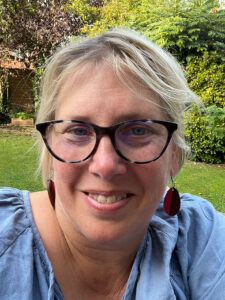
I am delighted to announce that Fiona Moss, currently National Adviser at RE Today Services and Chief Executive of the National Association of Teachers of RE is to become our new Education and Programmes Manager. Fiona has worked with local authorities, dioceses and multi- academy trusts. She brings a wealth of skills, experience and expertise to this role and will begin working with us on 1st September 2024. I have had the pleasure of working with Fiona over several years and am thrilled to welcome her to our staff team.

Photo of Fiona Moss in a garden

Fiona says,

I’m really excited to be joining Culham St Gabriel’s. All through my career I have been passionate about RE/religion and worldviews and developing others in their career. Culham St Gabriel’s is an organisation that builds partnerships, builds people and informs and influences educationalists and stakeholders. I’m over the moon to be able to be part of the team. Whilst it is sad to leave all the people I have worked with at RE Today and NATRE for the last 15 years I know that this job will mean I can build on those relationships to make a difference in the field of religion and worldviews.


Five years ago, today I started as Chief Executive of Culham St Gabriel’s Trust. I think because much of that time was impacted by Covid-19 it seems to have gone extremely quickly!!! As I think back over the last few years, I am particularly struck by the amazing people I work with on a day-to-day basis within our Culham St Gabriel’s team, but also more widely with an increasing number of stakeholders and partner organisations. Someone asked me the other day what I like most about my job. I truly said, ‘all of it’! However, the opportunity to bring about change and make a positive difference is what energises me each morning.

In the last few years Culham St Gabriel’s has refined its vision, but also broadened its reach. Many of you will know the Trust through our RE:ONLINE website, and five years ago this was probably the most important programme we ran. I still believe it is vital, but we have also developed new activities and reshaped existing programmes such as our four scholarships (Masters, Doctoral, CTeach, Leadership), RExChange and our e-learning platform. We have created a ‘family’ of grant-funded projects. We have launched campaigns relating to teacher recruitment, public perception and freedom of religion or belief. We are increasingly engaged in policy and advocacy work and are using our influence within the wider educational sector.

In light of this, we have decided to bring a little more coherency to our brand over the coming months. This means we can engage with a range of audiences more easily.

Firstly, we are going to use one logo for all our work, and programmes like RE:ONLINE and RExChange will use this logo too. We also have a new strapline ‘Championing religion and worldviews education’. This says very clearly what we are about!

You will notice that the @reonline_tweets handle is changing to @culhamstgabriel and that our Facebook page has also changed from RE:ONLINE to Culham St Gabriel’s. This aligns them with our Instagram and LinkedIn handles. Our newsletter will also soon be branded as Culham St Gabriel’s, rather than RE:ONLINE.

The RE:ONLINE website is getting a bit of a refresh so it looks and feels more like the Culham St Gabriel’s website. This will take place over the coming few months.

This week for me is a great example of how Culham St Gabriel’s is reaching into diverse spaces and where coherency of our brand vital. We met with school improvement leads at a Confederation of School Trusts conference, are attending a conference on The Bloom review One Year On, and then supporting the RE Council of England and Wales with the launch of the religion and worldviews approach handbook.

I hope over the next five years we can champion religion and worldviews education together.

Ofsted’s recently published Deep and Meaningful? The religious education subject report (2024) is a sobering read. However, there is hope.

Others have provided some helpful summaries[1] outlining Ofsted’s call for updated guidance from the DfE, the lack of depth and substance to the curriculum, over emphasis on teaching to an exam, long gaps between lessons and the need for subject specific professional development. The report foregrounds issues which those of us working directly in this field have raised for some time and have lobbied government about alongside our partners such as NATRE and the RE Council of England and Wales.

However, there is also hope. There are examples of effective practice where teachers are exemplifying scholarly and ambitious approaches to the subject. There are signs that some senior leaders are taking the subject very seriously despite the pressures on curriculum time, valuing its importance for young people in an increasingly complex world. In many ways this report is a call to action within educational establishments and a call for action by the current and future governments.

The recommendation that government should urgently update guidance reinforces the significance of the recently published National Content Standard for RE in England (RE Council 2023). As a charity which champions religion and worldviews education we have actively supported this publication and continue to lobby for its wider endorsement. In addition, we look forward to the publication by the RE Council in early May of a curriculum toolkit to support a religion and worldviews approach based on research and good practice.

Two of the factors which Ofsted highlight as contributing towards better quality RE are strong teacher subject knowledge and access to professional development. Culham St Gabriel’s provides freely accessible subject knowledge support through RE:ONLINE and our e-learning platform. Our varying scholarships, particularly our leadership programme exemplify the areas of professional development which Ofsted highlights- namely policy, curriculum subject knowledge, pedagogy and research. Some of our grant funded projects are also contributing to an understanding of assessment and curriculum breadth and depth.

At Cullham St Gabriel’s we will continue to do all we can to secure a religion and worldviews education which is deep and meaningful for all children and young people.

To find out more about our support for teachers:
Sign up to our newsletter
Check out our free e-learning courses
Find out more about our advocacy work

[1] see for example:

NATRE – OFSTED ‘Deep and Meaningful The Religious Education Subject Report April 2024’

RE Counci of England and Wales – Comment on Ofsted’s report on RE “Deep and meaningful? The religious education subject report” from RE Policy Unit.

Schools Week – Ofsted criticises ‘limited and poor quality’ RE lessons

Many of you will know that government funding for subject knowledge enhancement (SKE) courses for RE has been cut from 10th April this year. In light of this a small group have got together to create a list of largely free alternatives that may be of interest to all ITT providers. We hope you find it helpful.

Developments at Culham St. Gabriel’s Trust

We are sure many of you will have noticed the recent changes within the staff team at Culham St Gabriel’s. In the last few months, we have welcomed Taylor as our Communications Officer, Liz as our Finance and Administration Officer, and most recently Julia as our Grants, Governance and Partnership Manager.

Today we are advertising one final new role, an Education and Programmes Manager. You can read more about this here. The changes to personnel structure, including this latest new role, will enable us to fulfil our strategy as effectively as possible, build capacity, support more teachers and be an even greater ambassador for religion and worldviews education.

However, this change also means that we will be saying goodbye to some of our consultants at the end of August as their work will be taken forward by the person who is appointed to this role. We want to say publicly that the work of our consultants has been of outstanding quality over the last few years. Each of them has contributed greatly to the work of the Trust and they have been a dedicated and creative team. We know that many of you have benefited from their expertise, advice and support. We plan to continue partnering with many of them in new ways over the coming years.

We plan to say a huge thank you to our consultants later this term.

Kathryn Wright Chief Executive, Linda Whitworth Chair of Trustees

Subject Knowledge Enhancement (SKE) courses are indispensable in the realm of teacher education, especially in the preparation of teachers for intricate subjects like Religious Education (RE). The recent decision by the Department for Education (DfE) to withdraw funding from SKEs for RE has sparked significant concerns within the RE community. This decision, attributed to budget constraints and policy shifts within the DfE, was made without adequate notice, exacerbating apprehensions among training providers.

The ramifications of this decision are profound, particularly in the recruitment of RE trainee teachers. Despite efforts such as the introduction of an Initial Teacher Training (ITT) bursary to stimulate RE recruitment, projections indicate that recruitment will still fall short of targets. The DfE’s stance on prioritizing funding for subjects facing significant recruitment challenges, such as mathematics, physics, chemistry, computing, and languages, disregards the persistent under-recruitment in RE over the past decade. RE attracts candidates from diverse backgrounds, enriching the teaching landscape, but this diversity underscores the crucial role of SKE courses in ensuring a versatile and well-prepared teaching workforce. The future of RE teacher training now hangs precariously in the balance.

Critiques of the DfE’s justifications are warranted. The assertion that the number of RE trainees engaging with SKEs is relatively small belies its significance, as it constitutes 30% of the current training cohort, without which the subject would be in a considerably worse position. Additionally, the claim that RE SKEs account for only 3% of the overall SKE budget overlooks their vital contribution to RE training and any reasoning behind cost saving. Suggestions that trainees can supplement their knowledge post-ITT using generic resources contradict the imperative of high-quality specialist subject knowledge and training advocated by Ofsted. Moreover, the persistence of non-specialist teachers teaching RE underscores the inadequacy of such justifications.

The importance of SKE courses is exemplified by individuals like Syara Bano, a former Edge Hill University PGCE trainee, whose valuable RE teaching career continues to thrive thanks to the SKE boost. Her testimony underscores the invaluable role of SKE courses in shaping proficient RE teachers: https://www.edgehill.ac.uk/person/syara-bano/student/

It is imperative that the current and future governments address these concerns and reinstate funding for RE SKE courses to ensure the continued excellence of RE teacher training.